- TradFi-DeFi Report
- Posts
- Donroe Doctrine Energy Meets Digital Power
Donroe Doctrine Energy Meets Digital Power
Venezuela, Geopolitics, and Institutional Digital Asset Implications

Antoinette Rodriguez, MBA
February 13, 2026
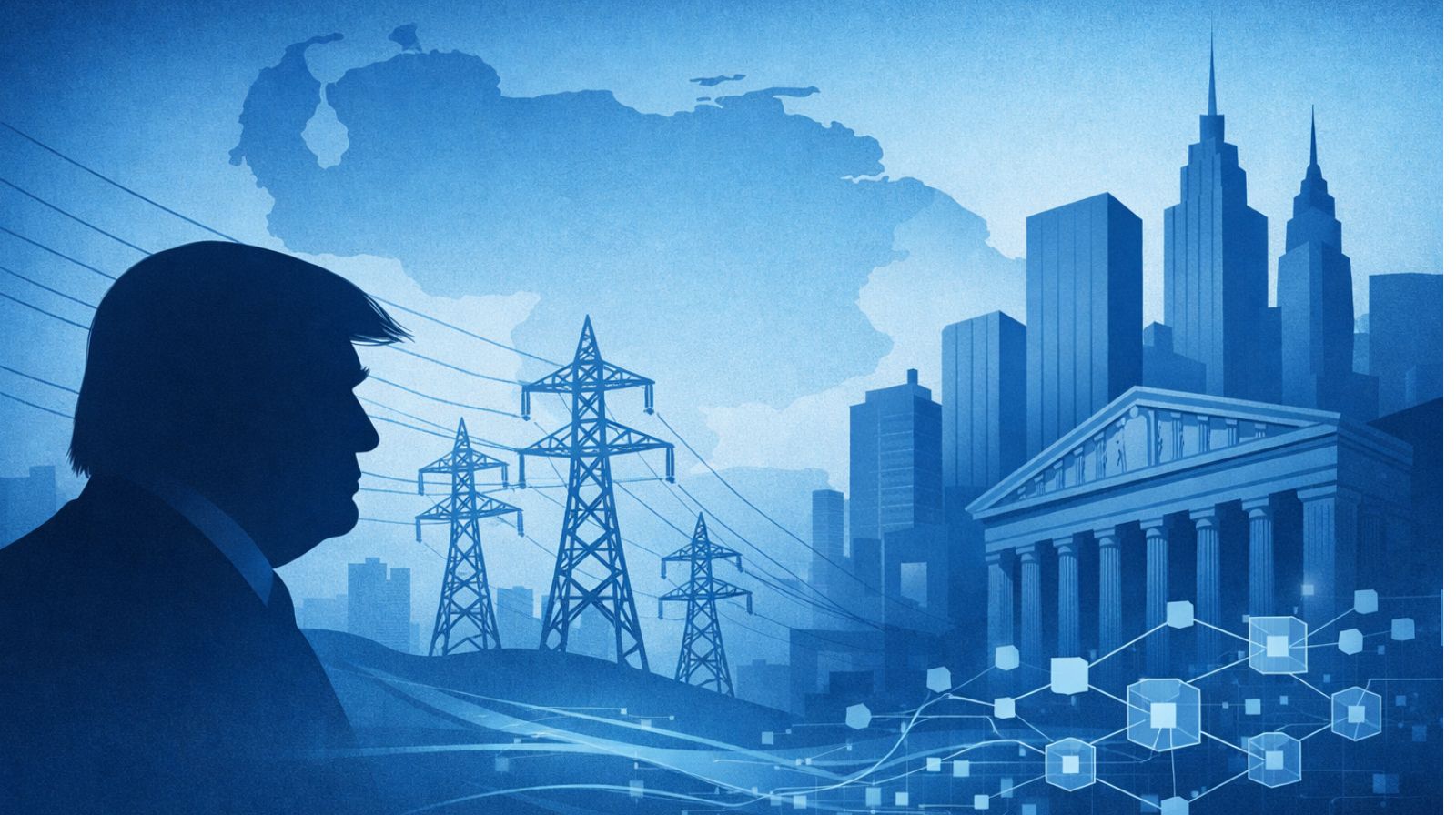
Energy dominance is not a competing narrative to digital assets—it is the enabling layer beneath them.
Recent U.S. actions in Venezuela, alongside renewed discussion of a modernized Monroe Doctrine—often referred to as the Donroe Doctrine—have drawn attention to the role of energy in shaping economic and strategic influence in the Western Hemisphere. While these developments are frequently discussed in terms of oil markets and regional security, they can also be viewed more fundamentally as signals of how control over energy functions as a prerequisite for modern infrastructure dominance. From an institutional digital asset perspective, this matters because digital asset networks are inherently energy-intensive systems whose economics, scalability, and geographic viability are determined well before a transaction settles. As states place greater emphasis on energy security and strategic resources, they also shape the environments in which digital financial infrastructure can be built, sustained, and legitimized at scale. In that sense, energy dominance increasingly serves as an enabling layer for digital power, rather than a parallel consideration.
Energy as the First Input, Not the Last Outcome
Energy has always underwritten economic power, but in periods of geopolitical stability it fades into the background, treated as an input assumed to be available, priced, and fungible. What recent developments suggest is a shift away from that assumption. Energy is no longer being treated merely as a commodity to be traded efficiently, but as a strategic asset to be controlled, secured, and prioritized.
This reframing matters because modern economic systems are no longer defined primarily by labor or even capital, but by infrastructure: physical, digital, and increasingly hybrid. Energy sits beneath all of it. Manufacturing, logistics, data centers, telecommunications, and financial markets each rely on stable, abundant, and affordable power. When states re-prioritize energy security, they are implicitly reshaping the economics of every system built on top of it.
For digital assets, this is not an abstract observation. It is structural.
From the Monroe Doctrine to the Donroe Doctrine